Topics
Tiimatuvat: The Art of Building a Traditional Finnish Craft

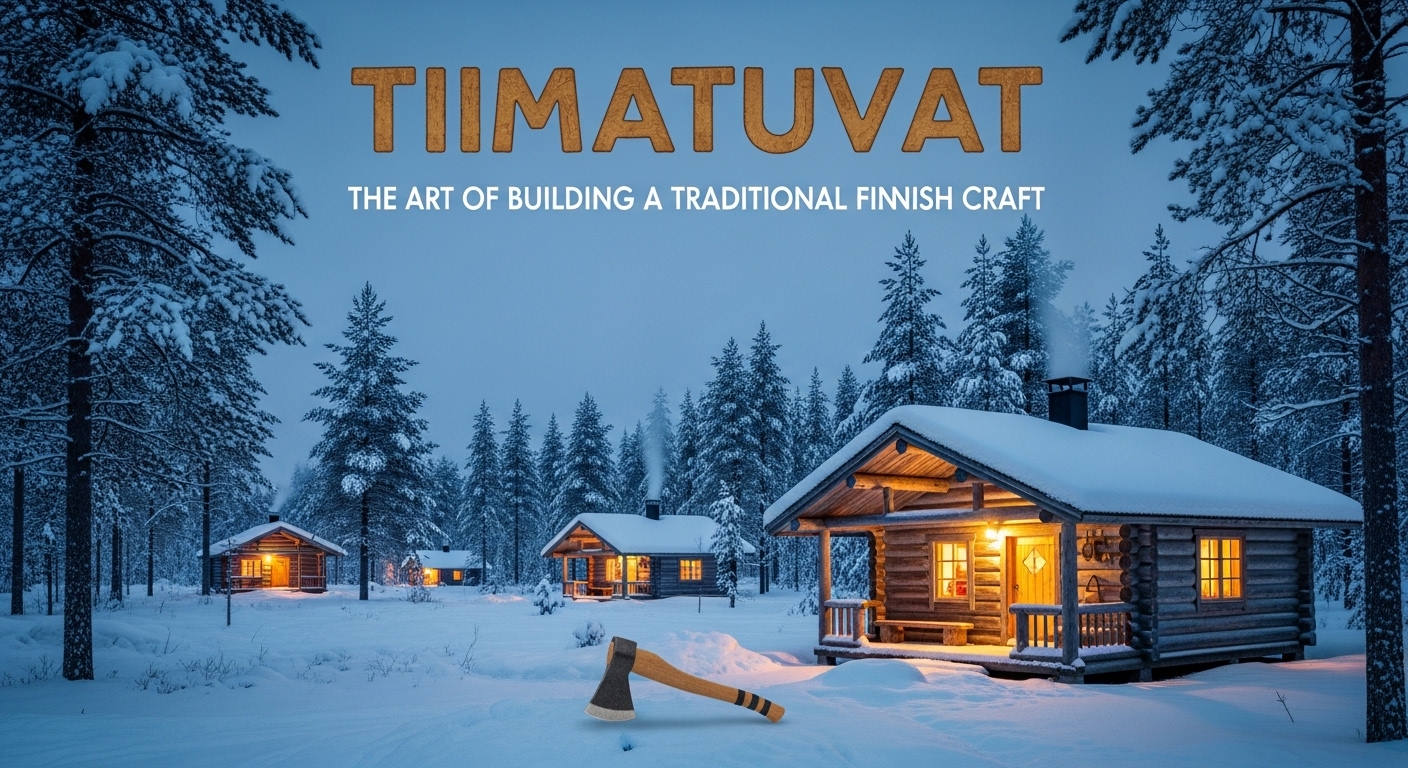
In the quiet corners of northern Finland, where pine forests stretch like endless green oceans and winter light lingers with a pale, almost suspended glow, there exists a craft that feels less like construction and more like memory being shaped into form. The practice of tiimatuvat has survived through generations not because it is efficient or industrially scalable, but because it carries something rarer: meaning embedded in wood, stone, and human patience.
To encounter tiimatuvat for the first time is to witness a dialogue between land and builder. It is not simply about assembling structures; it is about listening to what the environment allows, and responding with restraint rather than dominance. In an era where architecture often chases speed and scale, tiimatuvat stands quietly apart, almost stubbornly rooted in slowness.
The Meaning Behind Tiimatuvat
At its core, tiimatuvat refers to a traditional Finnish approach to crafting small, enduring wooden structures often seasonal shelters, communal huts, or storage dwellings designed to harmonize with the harsh Nordic environment. While the term itself is deeply tied to regional dialect and rural craftsmanship, its philosophy extends far beyond literal construction.
Tiimatuvat is less about what is built and more about how it is built. It emphasizes harmony with material, respect for forest ecosystems, and a cyclical understanding of time. Nothing is rushed. Nothing is wasted. Every beam carries intention, and every joint is shaped with the expectation that it will be touched again by frost, wind, and generations of human use.
For entrepreneurs and technologists observing from afar, tiimatuvat offers an unexpected lesson: resilience is not engineered through complexity alone, but through alignment with natural constraints.
Roots in Finnish Landscape and Identity
The origins of tiimatuvat are inseparable from Finland’s environmental and cultural history. Rural communities once depended on lightweight, adaptable structures that could be repaired or relocated depending on seasonal needs. These buildings were not monuments; they were companions to survival.
In regions where winters could stretch endlessly and daylight was a fleeting guest, construction had to be both practical and emotionally sustaining. Tiimatuvat emerged as a response to this dual need. The structures were simple enough to maintain without specialized tools, yet crafted with a precision that reflected deep respect for craftsmanship.
Over time, these buildings became more than utility. They became symbols of continuity. Families would pass down building techniques as part of oral tradition, embedding personal stories into the very grain of the wood they shaped.
The Philosophy of Material Intelligence
Modern architecture often treats materials as passive inputs. Tiimatuvat reverses this logic entirely. In this tradition, wood is not merely chosen it is understood.
Builders learn to read the forest like a text. A pine tree that has endured harsh winds develops different structural qualities than one grown in sheltered soil. These differences are not corrected; they are embraced. The philosophy assumes that imperfection, when properly understood, becomes strength.
This mindset aligns surprisingly well with modern ideas in systems thinking and adaptive design. In fact, many engineers today would recognize tiimatuvat as an early form of material intelligence where decision-making is guided by environmental feedback rather than rigid specification.
A Craft That Resists Industrial Logic
One of the most compelling aspects of tiimatuvat is its resistance to industrialization. It does not scale easily. It does not benefit from mass production. And yet, it persists.
The reason lies in its human-centered rhythm. Every structure requires observation, patience, and iteration. Builders often return to the same site multiple times, adjusting based on weather, soil condition, and even seasonal light patterns.
This is where tiimatuvat becomes particularly relevant for modern founders and innovators. It challenges the assumption that progress must always accelerate. Instead, it suggests that certain forms of value only emerge when time is allowed to participate in the design process.
Craftsmanship in Practice
The process of building tiimatuvat structures follows a loosely structured but deeply intuitive sequence. While methods vary across regions, the underlying approach remains consistent: observe, select, shape, and integrate.
Below is a simplified comparison of traditional tiimatuvat craftsmanship versus modern construction approaches that attempt to preserve its essence.
| Aspect | Traditional Tiimatuvat Approach | Modern Adaptation |
|---|---|---|
| Material Selection | Locally sourced, seasonal wood chosen by observation | Pre-processed, standardized timber |
| Design Philosophy | Evolved organically through environment interaction | Pre-designed architectural plans |
| Construction Speed | Slow, iterative, weather-dependent | Fast, schedule-driven |
| Skill Transfer | Oral tradition and apprenticeship | Formal engineering education |
| Environmental Relationship | Symbiotic and adaptive | Compliance-based sustainability |
| Structural Identity | Unique per location and builder | Replicable and uniform |
What becomes immediately clear is that tiimatuvat is not simply a method it is a worldview. It rejects uniformity in favor of responsiveness, and in doing so, creates structures that feel almost alive within their environment.
The Hidden Economy of Craft Knowledge
In recent years, there has been a quiet resurgence of interest in traditions like tiimatuvat among designers, architects, and sustainability researchers. This is not nostalgia in the superficial sense. Rather, it is a search for alternatives to systems that have become overly optimized and disconnected from place.
Small workshops in Finland and neighboring Nordic regions have begun revisiting these techniques, not to replicate the past, but to extract principles that can inform future design. Interestingly, much of this knowledge transfer now happens informally through apprenticeships, rural residencies, and interdisciplinary collaborations.
For entrepreneurs, this represents what could be called a “hidden economy of craft knowledge.” It is not visible on balance sheets or market reports, but it influences how spaces are designed, how materials are sourced, and how communities engage with their built environments.
Tiimatuvat and the Future of Sustainable Design
Sustainability is often discussed in terms of efficiency metrics carbon reduction, energy savings, and material optimization. Tiimatuvat expands this conversation by introducing emotional and temporal sustainability.
A structure built using tiimatuvat principles is not designed to be replaced every decade. It is designed to evolve. Walls are repaired rather than discarded. Foundations are adapted rather than demolished. In this way, sustainability is not a target; it is a lived practice.
This approach resonates strongly with emerging movements in regenerative design, where the goal is not simply to reduce harm, but to create systems that actively restore balance over time.
Lessons for Modern Builders and Technologists
For those working in technology, product design, or architecture, tiimatuvat offers a subtle but powerful set of lessons. The first is humility. Not every system needs to be optimized to its maximum theoretical efficiency. Some systems function better when allowed to breathe.
The second is attentiveness. Tiimatuvat requires deep observation of context something often overlooked in fast-paced development cycles. Whether building software or physical structures, understanding the environment is often more valuable than controlling it.
Finally, there is the lesson of continuity. In tiimatuvat, nothing is truly finished. Everything remains in conversation with time.
The Quiet Relevance of Tiimatuvat Today
In a world increasingly defined by digital acceleration and automated decision-making, tiimatuvat feels almost countercultural. Yet its relevance is growing precisely because of this contrast. It reminds us that not all progress is vertical. Some of it is circular, returning again and again to foundational principles of care, observation, and restraint.
It is not a rejection of modernity, but a correction of imbalance.
Conclusion
Tiimatuvat is more than a traditional Finnish craft it is a philosophy of building that challenges how we think about time, material, and human presence in the landscape. In its quiet resilience, it offers a reminder that true innovation does not always announce itself loudly. Sometimes it exists in the slow alignment of hand, material, and environment, repeated across generations.
As industries continue to search for sustainable and meaningful models of creation, the principles embedded in tiimatuvat may prove not only relevant but essential. They suggest that the future of building may depend less on invention, and more on remembering how to listen.

-

 Home+Design6 months ago
Genevieve Gorder, Design Star
-

 Luxury Auto6 months ago
Paul Teutul Senior: Ultimate Collector
-

 Dining+Entertainment6 months ago
The $200,000 Cigar
-

 The Life5 months ago
Who is Mary Joan Schutz? The Story of Gene Wilder’s Second Wife
-

 The Life6 months ago
The Life: Della Crews
-

 The Life6 months ago
Judy Schelin: The Inspiring Journey of Her Life and Legacy
-

 People+Places6 months ago
The Rise And Rise Of Wendy Williams
-

 The Life6 months ago
Daisy Fuentes’ Just Getting Started